Your GTM stack was supposed to make selling easier. Instead, your SDR spends 72% of their time toggling between tabs, exporting CSVs, and praying the Zapier integration holds. Sound familiar?
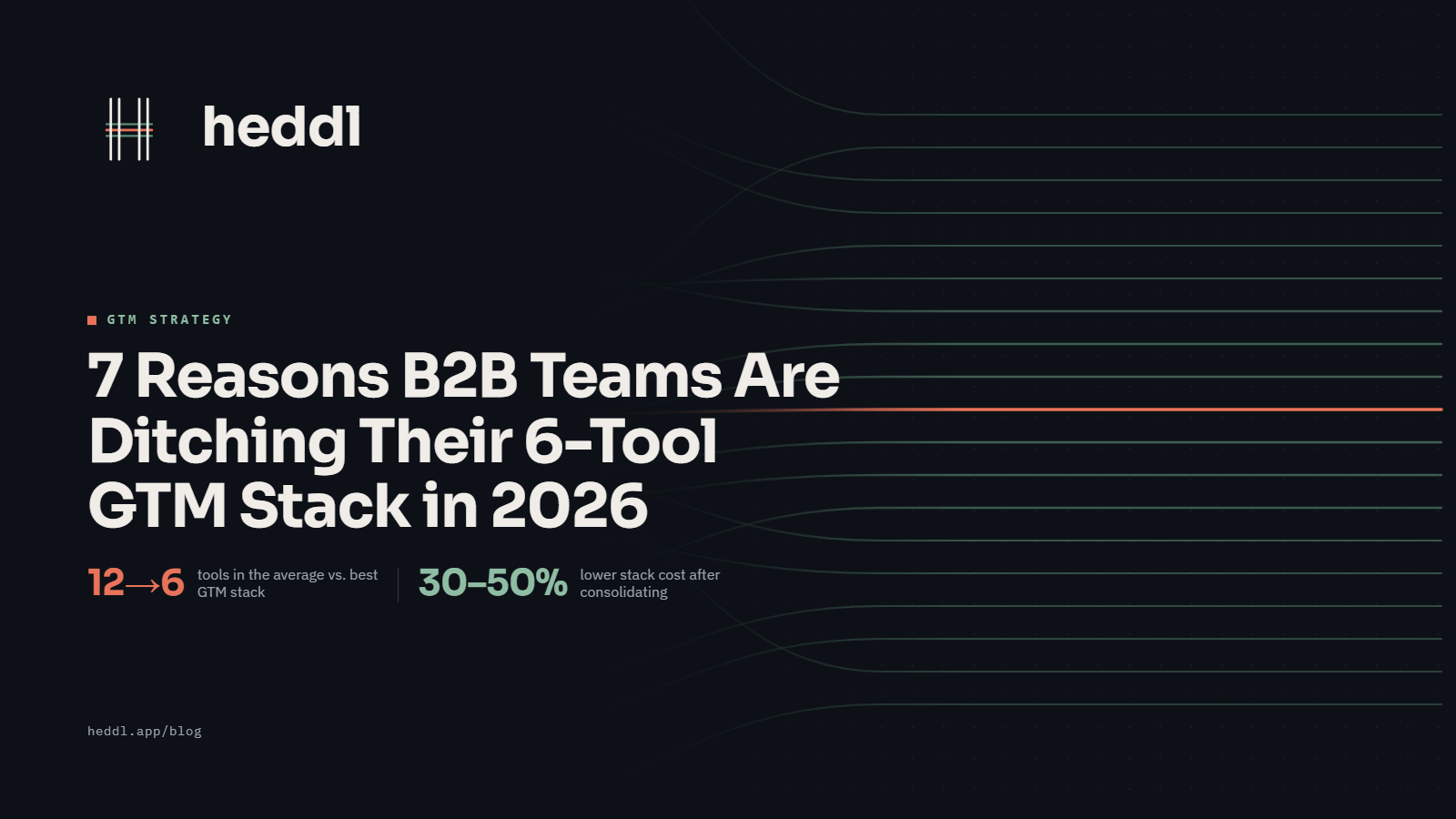
Here is the uncomfortable math: the average B2B sales team runs 12 tools. The best teams run 6. And the gap between those two numbers is not just a budgeting issue, it is a pipeline issue, a speed issue, and increasingly, a survival issue.
$600–$2,000/month is the typical cost of a disconnected GTM stack (HeyReach + Clay + Apollo + Lemlist + content tools)
The 2026 trend is undeniable: GTM teams are consolidating. They are moving from 10–15 point solutions to 3–5 core platforms, and the ones doing it first are closing deals faster, spending less, and outperforming teams still duct-taping their stacks together. Here are the 7 reasons driving this shift and why it matters for your pipeline.
1. Integration Tax Is Killing Your Pipeline Velocity
Every tool you add to your stack introduces what engineers call "integration debt." Each new API connection is another point of failure. Each CSV export is another opportunity for data to go stale. Each login is another context switch that pulls your reps away from the one thing that actually generates revenue: talking to buyers.
When your enrichment data lives in Clay, your sequences live in Lemlist, and your LinkedIn automation lives in HeyReach, no single system has the full picture. Your reps are the integration layer, and they are terrible at it not because they are bad at their jobs, but because manual data reconciliation should never have been their job in the first place.
28% - the amount of time sales reps actually spend selling (the rest is lost to admin, CRM updates, and tool-switching)
2. Data Silos Mean Slower Decisions
When your social listening data is in one platform, your email engagement data is in another, and your LinkedIn activity is in a third, you cannot make fast, informed decisions. You are assembling a jigsaw puzzle across three different tables in three different rooms.
Consolidated platforms solve this by keeping every data point from the initial market signal to the final reply, all inside one system. When an SDR can see that a prospect just posted about switching CRM vendors, received your email two days ago, and accepted your LinkedIn connection yesterday, that is not just data. That is a warm conversation waiting to happen.
3. The "Best-of-Breed" Myth Is Expensive
For years, the prevailing wisdom was to pick the best tool in each category: the best enrichment tool, the best sequencer, the best LinkedIn automation. The theory sounded smart. The reality was a $2,000/month Frankenstein that required a full-time RevOps engineer to keep alive.
Research shows that teams report 30–50% reduction in total stack cost when they consolidate effectively. That is not a marginal saving, it is the difference between hiring another SDR or not. The best-of-breed approach only makes sense when you have the engineering capacity to maintain 6+ integrations without it becoming a bottleneck. Most teams under 50 people do not.
4. Speed Wins Deals and Fragmented Stacks Are Slow
Here is a stat that should change how you think about your stack: deals closed within 50 days show a 47% win rate, compared to just 20% for deals extending beyond that threshold. Every week a deal lingers, the odds shift against you.
AI-powered consolidated tools accelerate deals through the pipeline. Teams using conversation intelligence close deals 11 days faster on average. When your platform handles the entire workflow - signal detection, enrichment, sequence creation, and multichannel execution — you remove the dead time between steps that fragmented stacks impose.
47% vs 20% - win rate for deals closed within 50 days vs. deals that extend beyond that window
5. Only 17% of the Buying Journey Involves a Sales Rep
According to Gartner's 2026 buying research, buyers complete 57–70% of their evaluation before they contact anyone. That means you need to be present before buyers raise their hand through the right signals and outreach at the right moment.
A consolidated platform that combines social listening with outreach execution lets you detect buying signals and act on them in the same workflow. No exporting. No switching tools. No losing the thread. The signal fires, the sequence launches, and your rep gets the reply, all inside one platform.
6. Multichannel Is No Longer Optional
Single-channel outreach is functionally dead in 2026. Outreach using email, phone, and LinkedIn together increases response rates by 287% compared to single-channel efforts. But running multichannel from separate tools is like conducting an orchestra where each musician is in a different building.
When your LinkedIn sequences live in HeyReach, your email cadences live in Instantly, and your WhatsApp follow-ups are manual, the "multichannel" experience your prospect receives is disjointed at best and contradictory at worst. A single platform that orchestrates all three channels ensures your messaging is consistent, your timing is coordinated, and your reps are not drowning in tab management.
7. AI-Native Beats AI-Bolted-On
There is a critical difference between tools that were built around AI from day one and legacy tools that bolted on AI features in 2024 to keep up. AI-native platforms are architecturally designed to improve as models advance. Bolted-on AI features often plateau because the underlying data model was not designed for them.
The winning GTM stack for 2026 is simple: one clean CRM, one signal layer, one outbound engine, and one content layer working together with tight workflows and strong AI automation. That is not a stack. That is a platform.
What Should You Do This Week?
Run a stack audit. List every GTM tool you pay for, its monthly cost, its owner, and the one job it does that nothing else does. Anything that fails that last test is a consolidation candidate. Then calculate your total cost of ownership, not just subscription fees, but the RevOps time, the integration maintenance, and the pipeline velocity you are losing to context-switching.
The teams that consolidate in 2026 will save money, reduce RevOps overhead, and execute faster. The teams that keep adding tools will fall further behind.
👉 Ready to replace your 6-tool stack with one platform? See how Heddl combines social listening, GTM intelligence, content, and multichannel outreach from $30 → heddl.app
TL;DR — Key Takeaways
The average B2B team runs 12 tools; top performers run 6. Integration tax kills pipeline velocity, your reps spend 72% of their time not selling. Consolidated stacks cut costs 30–50% and close deals faster. Multichannel outreach boosts response rates by 287%, but only works when orchestrated from one platform. AI-native platforms outperform bolt-on AI features. Run a stack audit this week and identify your consolidation candidates.
👉 Share this with your VP of Sales who just approved another $200/month tool subscription. They need to see this.
About Heddl
Heddl is the AI-native GTM platform that combines social listening across 9 channels, GTM intelligence strategy, AI content intelligence, and multichannel outreach (LinkedIn, email, WhatsApp) in one workflow. Replace your entire $600–$2,000/month tool stack from $30. Learn more at heddl.app.