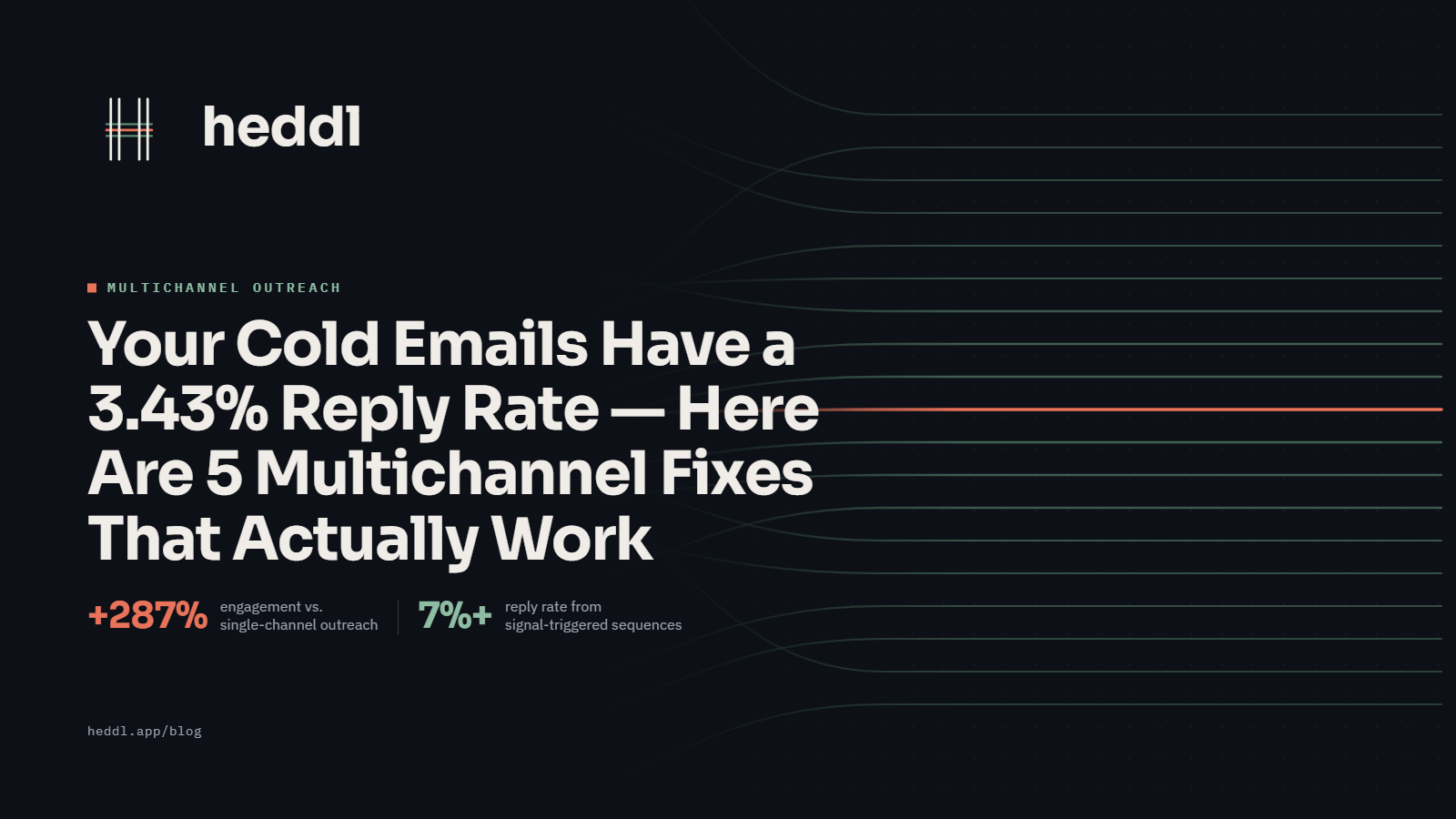
Outbound sequences that coordinate LinkedIn, email, and WhatsApp generate up to 287% more replies than single-channel outreach. The performance gap comes down to the recognition effect: prospects are statistically more likely to respond when they have seen your name in at least two different professional contexts before you ask for anything.
TL;DR
Cold email reply rates have fallen to 3.43% in 2026. LinkedIn direct messages average 10-15%. Run both in a coordinated sequence and reply rates climb to 15-25% on tight ICPs. Add WhatsApp as a final touchpoint in relevant markets and combined response rates hit 40%. The infrastructure already exists. Most teams just are not using it together.
You have spent two hours crafting the perfect cold email. Subject line tested, opening line personalised, CTA clear. You hit send. And then nothing. You wait four days, send a follow-up. Still nothing. You archive the thread and move on to the next name on the list.
If this sounds familiar, the problem probably is not your copy. It is your channel strategy. Most outbound teams run one channel at a time, email or LinkedIn, and wonder why reply rates keep slipping. The data on what actually works in 2026 tells a very different story. Prospects respond when they recognise your name. Recognition happens through repetition across channels. The teams hitting 15-25% reply rates are not writing better emails. They are running coordinated sequences that make the ask feel like a follow-up to a relationship, not a cold interruption.
What the Reply Rate Data Actually Shows in 2026
Cold email averages 3.43% reply rates. LinkedIn direct messages average 10-15%. Multichannel sequences combining three or more channels deliver 287% more responses than single-channel outreach.
According to the 2026 Instantly cold email benchmark report, cold email reply rates have dropped from 8.5% in 2019 to 3.43% today. That is not a temporary dip. It is a structural decline driven by inbox saturation, better spam filters, and a flood of low-quality AI-generated outreach hitting every inbox at once.
LinkedIn tells a better story, but not for the reason most people assume. It is not that LinkedIn is a warmer channel. It is that LinkedIn is still less crowded. Direct message reply rates average 10-15% post-connection, jumping to 20-30% with strong personalisation. Connection requests get accepted by around 26-27% of prospects when accompanied by a personalised note.
The real number is the multichannel one. Sequences using three or more coordinated channels deliver 287% more responses than single-channel outreach, according to benchmarks published by Outreaches.ai across millions of outreach attempts. That figure is not an outlier. Studies from Overloop and Instantly.ai report that coordinated LinkedIn and email sequences alone produce 3-4x the reply rate of either channel running independently.
Why the recognition effect works
When a prospect sees your name in two separate professional contexts, the trust threshold drops. They have already processed who you are before you make the ask. B2B buying research shows buyers now need 6-8 touchpoints before engaging a salesperson. Running those touchpoints across channels rather than stacking them in one inbox accelerates that process without the spam feeling of aggressive follow-up.
How to Structure a Coordinated Sequence That Gets Replies
The highest-performing sequences run LinkedIn first to build recognition, email to deliver context and a clear ask, and follow-up on both to close the loop. Space touchpoints 2-3 days apart.
A sequence is not a blast. It is a choreographed set of touchpoints that builds familiarity before it asks for time. Here is the structure that consistently produces 15-25% reply rates on tight ICPs:
Day 1: LinkedIn connection request with a brief, relevant personalisation note. Not a pitch. One sentence about why you reached out.
Day 3: Cold email. Introduce yourself properly. Reference the LinkedIn connection if accepted. Be specific about why this person, why now.
Day 7: LinkedIn direct message (if connected). Short and conversational. Acknowledge the email you sent. Ask one specific question.
Day 10: Email follow-up. Shorter than the first. One sentence about what you can help with. One sentence CTA.
The spacing matters as much as the sequencing. Sending email, LinkedIn message, and WhatsApp on the same day does not feel persistent. It feels like a harassment campaign. Two to three days between channels gives the prospect time to notice you without overwhelming their attention.
Running this kind of coordinated sequence from separate tools is where most teams lose time. The LinkedIn step happens in one tab, the email step in another, and the follow-up reminder lives in a spreadsheet. Context gets lost between channels. Heddl was built specifically to solve this, unifying LinkedIn, email, and WhatsApp into a single intelligent workflow so each touchpoint has full context on what happened in every other channel.
When to Add WhatsApp and How to Use It Without Burning Trust
WhatsApp has a 95% open rate but only a 4% cold reply rate. Use it as a final touchpoint after LinkedIn and email, never as the first message.
WhatsApp is the highest open-rate channel in outbound. A 95% open rate is not a typo. But the 4% reply rate on cold WhatsApp outreach tells you the whole story. Prospects open it because it is intrusive by nature. They reply only when it feels earned.
The right positioning for WhatsApp in a B2B sequence is as the final touchpoint, not the opener. When you have already connected on LinkedIn, sent a personalised email, and followed up once, a brief WhatsApp message referencing the earlier email can push combined response rates to around 40% in WhatsApp-active markets like India, Southeast Asia, and Latin America. That number drops sharply if WhatsApp is the first channel, where it reads as a privacy violation rather than a professional follow-up.
For teams selling into those markets, this is a significant edge. WhatsApp as a first touch often damages deliverability in other channels because the prospect marks you as spam. WhatsApp as a final touch, with full context from prior interactions, converts at a rate most email-only teams have never seen.
Why Most Teams Still Run Single-Channel (And the Real Cost)
The barrier is not strategy knowledge. It is workflow fragmentation. Teams that know they should run multichannel sequences still do not, because coordinating three channels from three separate tools takes more time than the outreach itself.
Ask any SDR why they stick to email and the answer is consistent. It is the only channel where everything lives in one place. LinkedIn activity is manual. WhatsApp is a personal number on someone's phone. Coordinating three tools across a 10-day sequence for 50 prospects at once is genuinely difficult without a unified system.
The cost of staying single-channel is real. Multichannel campaigns close with 20% higher close rates, 20% lower customer acquisition cost, and 25% shorter sales cycles, according to research cited by Prospeo. Single-channel is not a conservative choice. It is an expensive one that compounds over every campaign you run.
The solution is not adding more tools. It is consolidating channels into a workflow where each touchpoint automatically has context from every prior interaction.
The Simple Framework to Start This Week
You do not need a new tool to start. Pick 20 accounts. Run the 4-step LinkedIn-email-LinkedIn-email sequence over 10 days. Measure reply rates. The gap from your current single-channel baseline will tell you whether to scale it.
Start with your highest-intent ICP segment. Not your full list. Twenty accounts with clear fit signals, a relevant trigger event if you have one, and a specific problem your product solves. Personalise the LinkedIn note to one specific thing about them. Keep the first email under 100 words. Make the ask a conversation, not a demo booking.
Run the full 4-step sequence. Track where replies come from across your 20 accounts. You will almost certainly see that prospects who connected on LinkedIn before replying to email convert at a higher rate than those who only saw the email. That is the recognition effect at work, and it is the clearest argument for making multichannel sequencing your default, not your experiment.
Gartner projects that by 2027, 95% of seller workflows will begin with AI-powered signal detection. Teams that are already coordinating channels and acting on triggers today are not just ahead on reply rates. They are building a motion that will be the baseline expectation within two years.
In Conclusion
Single-channel outreach is not broken. It is just operating at a fraction of its potential. The sequences that book the most meetings are not the ones with the best copy. They are the ones that show up in more than one place before they ask for anything. That shift from channel to sequence is the simplest thing most outbound teams can do right now to change their numbers.
Heddl unifies LinkedIn, email, and WhatsApp into a single outreach workflow so every touchpoint has full context on every prior interaction. No tab-switching, no lost threads, no sequences that fall apart mid-cadence. If multichannel sequencing is the next move for your team, see how Heddl works.