Picture this: your SDR sends 200 cold emails on Monday. By Friday, they have 3 replies - two of which are "please unsubscribe." Meanwhile, a prospect in your ICP just posted on LinkedIn about how frustrated they are with their current outreach tool. They are practically waving a flag that says "sell to me." But nobody on your team saw it.
That is the gap social listening closes. And in 2026, the teams filling the pipeline are not the ones sending the most emails. They are the ones listening the hardest.
The Cold Outreach Crisis in Numbers
Let us be honest about where cold outreach stands. The average cold email reply rate has declined from 8.5% in 2019 to 3.43% in 2026. That is a 60% decline in seven years. And it is getting worse: Belkins found that reply rates dropped 20% within 2025 alone, from 0.50% in the first half to 0.40% in the second half.
91% of cold outreach emails receive zero response
The reasons are structural, not tactical. Inbox saturation keeps growing - more teams are running cold outreach, which means more competition for the same inboxes. Spam filters are getting more sophisticated. And low-effort AI-generated outreach has flooded inboxes with emails that all sound the same. Your beautifully personalized email is competing with 47 other "I noticed you..." openers.
But here is the thing: cold outreach is not dead. What is dead is cold outreach without context.
What Is Signal-Based Selling (and Why It Works)
Signal-based selling is the practice of using real-time market signals - public posts, job changes, funding announcements, competitor reviews, hiring spikes to time and personalize your outreach. Instead of guessing who might be interested, you respond to evidence that someone already is.
Think of it this way: traditional cold outreach is shouting into a crowded room. Signal-based selling is overhearing someone in that room say "I need exactly what you sell" and then walking over to introduce yourself.
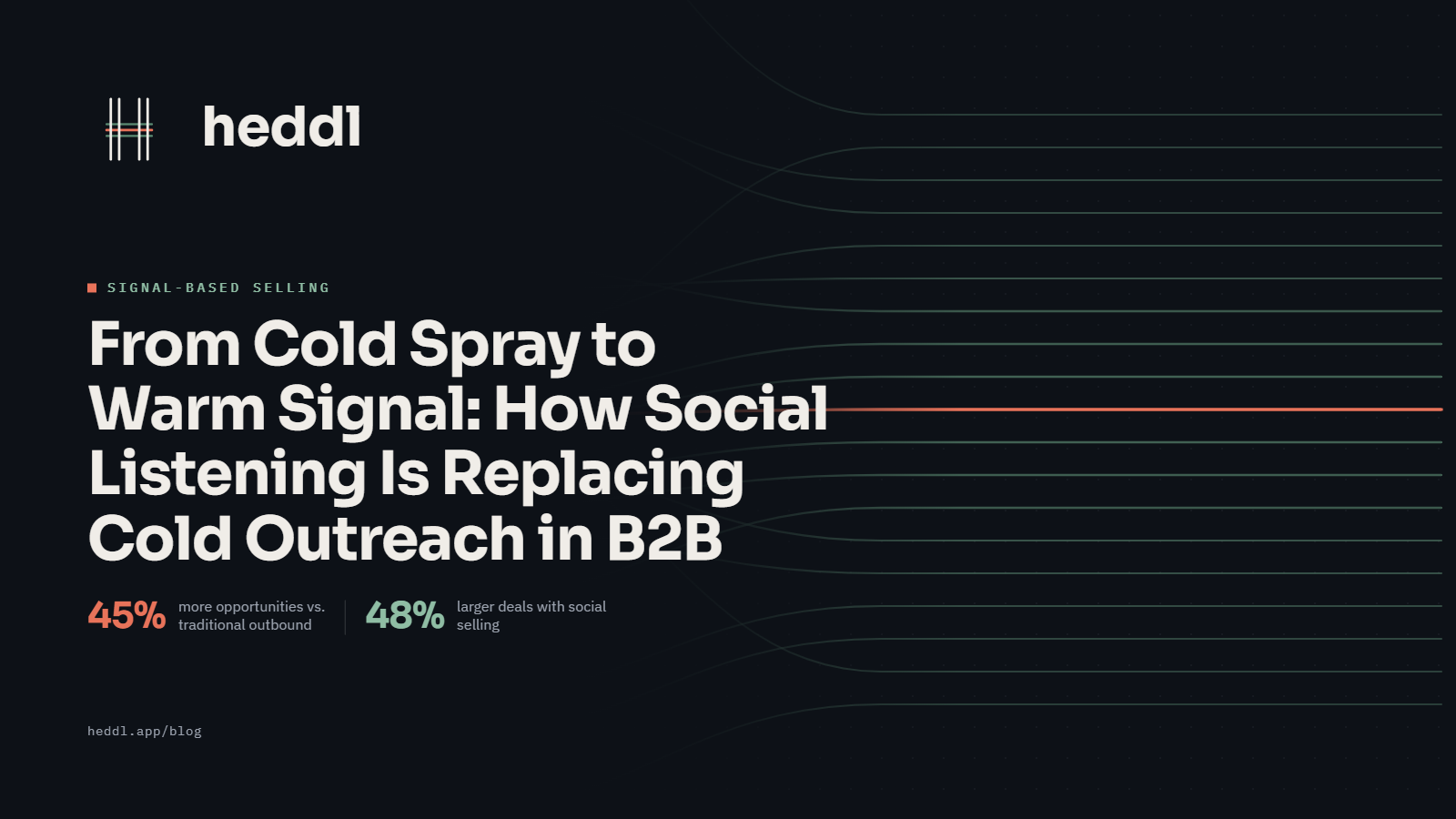
45% - more opportunities generated by sales teams using social selling vs. traditional outbound
The data backs this up decisively. Emails with advanced, signal-specific personalization achieve 18% response rates, more than five times the generic average of 3.4%. Sales reps with high Social Selling Index scores are 51% more likely to hit quota. And companies with social selling strategies see deals that are 48% larger on average.
The 9 Channels You Should Be Listening To
Most teams that attempt social listening only monitor LinkedIn. That is a start, but it misses where a huge portion of buying conversations actually happen. Here are the 9 channels where your prospects are publicly signaling intent right now:
1. LinkedIn
The obvious one. Prospects post about pain points, share vendor comparisons, announce role changes, and signal buying intent daily. But do not just monitor posts - watch comments on industry content, job postings, and company page updates.
2. Reddit
Subreddits like r/sales, r/startups, and industry-specific communities are where unfiltered opinions live. When someone asks "what's the best alternative to [your competitor]?" that is a buying signal wrapped in a forum post.
3. X/Twitter
Fast-moving conversations about vendor frustrations, market shifts, and product announcements. Particularly valuable for tech and SaaS prospects.
4–5. G2 and Capterra
Review platforms are goldmines. A 2-star review of your competitor is a warm lead. A prospect actively comparing tools in your category is further down the funnel than any cold email recipient.
6–7. YouTube and TikTok
Video content — especially founder vlogs, product reviews, and industry commentary reveals pain points and priorities that text content often misses. AI transcription makes this content searchable and actionable.
8–9. Instagram and Trustpilot
Brand presence signals on Instagram and customer sentiment on Trustpilot round out the picture. When a company's Trustpilot score drops, their customers are looking for alternatives.
From Signal to Sequence: The Practical Workflow
Listening is only half the equation. The magic happens when you connect signals directly to outreach execution. Here is what that workflow looks like in practice:
Step one: ingest. Your social listening tool monitors all 9 channels continuously, pulling in posts, reviews, videos, and conversations that match your ICP criteria and signal keywords.
Step two: classify. AI classifies each signal across buying intent dimensions, pain points, competitor mentions, feature requests, ICP fit, and market sentiment. Not every post is a buying signal, and your system needs to distinguish between someone venting about a bad day and someone actively evaluating vendors.
Step three: score and prioritize. Signals are scored by intensity and recency. A prospect who posted a detailed comparison of three competitors yesterday is a higher priority than one who mentioned a vague frustration two weeks ago.
Step four: act. The signal triggers a personalized outreach sequence, not a generic "I saw your post" message, but a response that demonstrates you understand their specific situation and can solve it.
7% - average cold outreach reply rate achieved by teams using intent-based sequencing (vs. 2% industry average)
Why Social Listening Beats Intent Data Providers
You might be thinking: we already buy intent data from Bombora or 6sense. How is social listening different? The answer is specificity and freshness.
Traditional intent data tells you that "Company X is researching CRM solutions." Social listening tells you that "The VP of Sales at Company X just posted on LinkedIn about how their current CRM is costing them 15 hours a week in manual data entry and they are evaluating alternatives before Q4 planning." One is a signal. The other is a conversation starter.
And here is the kicker: 80 - 90% of B2B buyers form their vendor shortlist before making formal contact. If you are waiting for inbound leads, you are competing for the 10 - 20% who bother to raise their hand. Social listening catches the other 80%.
What This Means for Your Team in Q3 2026
Start with one channel. If you are not doing any social listening today, start with LinkedIn. Monitor your ICP's posts, comments, and job changes. When you see a signal, craft a manual outreach message that references it. Measure the reply rate against your generic cold sequences.
Then expand. Add Reddit and G2/Capterra monitoring. These three channels alone will surface more warm opportunities than your entire cold email program. Once you have the workflow proven, automate it with a platform that connects signal detection to outreach execution.
The teams winning in 2026 are not louder. They are listening harder and showing up at the right moment with the right context. That is not magic - it is infrastructure.
👉 Heddl monitors 9 signal channels and connects every buying signal directly to multichannel outreach in one workflow, from $30. See how it works → heddl.app
TL;DR - Key Takeaways
Cold email reply rates have dropped 60% since 2019, now sitting at 3.43%. Signal-based selling generates 45% more opportunities and 48% larger deals. Social listening across 9 channels (not just LinkedIn) catches the 80% of buyers who never fill out a form. The winning workflow in 2026: listen, classify, score, actall in one platform. Intent-based sequencing achieves 7% reply rates vs. the 2% industry average.
👉 Share this post with the SDR on your team who just sent 500 cold emails with 2 replies. They deserve a better strategy.
About Heddl
Heddl is the AI-native GTM platform that combines social listening across 9 channels, GTM intelligence strategy, AI content intelligence, and multichannel outreach (LinkedIn, email, WhatsApp) in one workflow. Replace your entire $600–$2,000/month tool stack from $30. Learn more at heddl.app