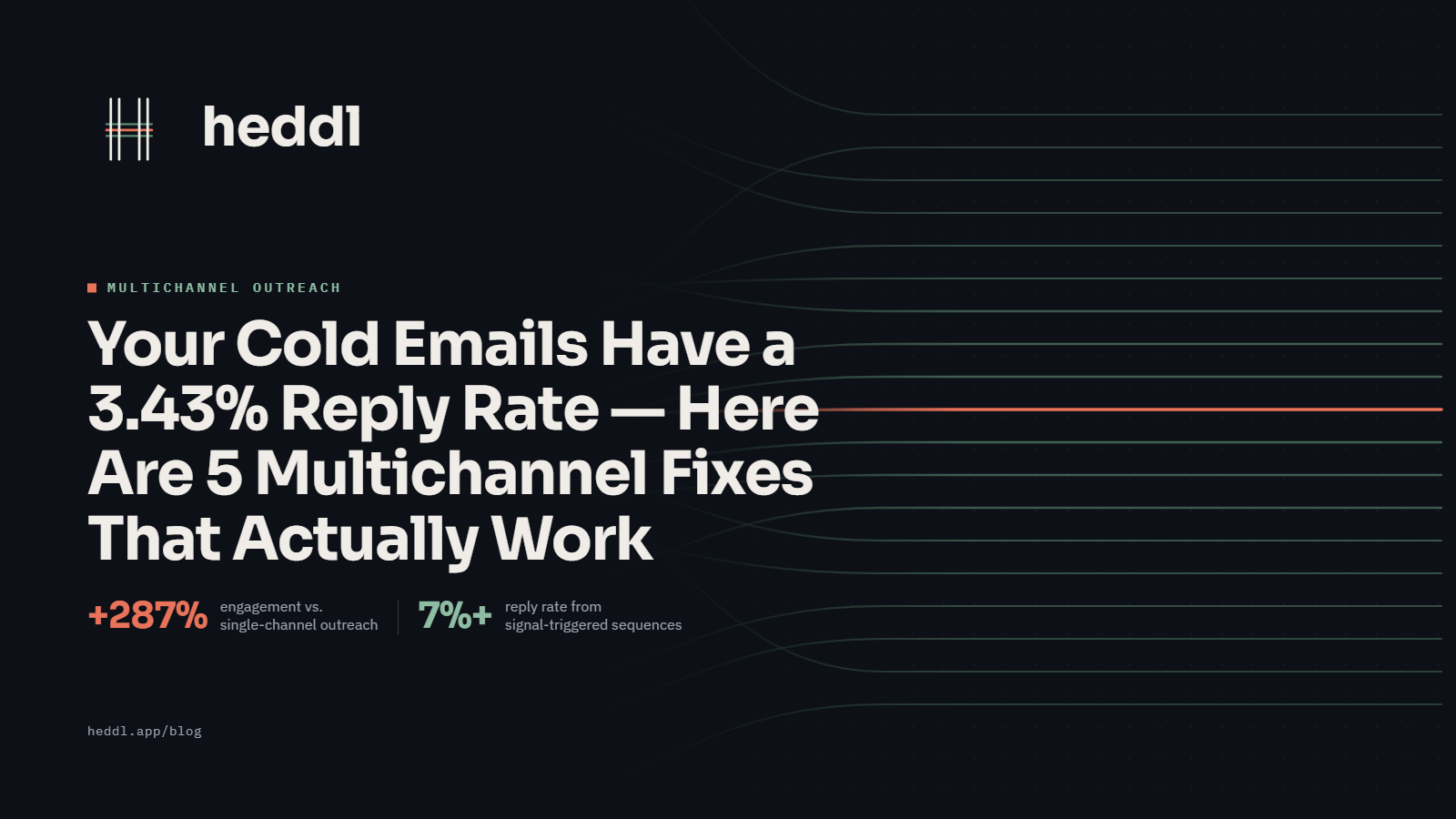
Here is a number that should make every sales leader uncomfortable: 3.43%. That is the average cold email reply rate in 2026, according to Instantly's benchmark study. And it is getting worse - reply rates have declined from 8.5% in 2019 to where they sit now, a 60% drop in seven years.
But before you declare cold outreach dead and pivot your entire team to inbound, consider this: multichannel outreach using email, LinkedIn, and a third channel together increases response rates by 287% compared to single-channel efforts. The channel is not broken. The approach is.
Here are 5 multichannel fixes that are actually working for B2B teams right nowbacked by data, not theory.
Fix 1: Stop Treating Email and LinkedIn as Separate Channels
Most B2B teams run their email sequences in one tool and their LinkedIn outreach in another. The result is two disconnected conversations with the same prospect. Your SDR sends a cold email on Monday, then a LinkedIn connection request on Tuesday, and neither message acknowledges the other.
The highest-replying outbound motion in 2026 is sequenced multichannel not parallel multichannel. Here is what that looks like:
Day 1: A buying signal triggers a LinkedIn connection request with a short personalized note referencing the signal.
Day 3: A cold email goes out referencing the same trigger.
Day 5: After they accept the connection, a LinkedIn DM follows up with additional value.
Day 8: A value-add email with a relevant case study.
Day 14: A soft close.
That sequence works because each channel covers the other's weakness. LinkedIn earns trust and establishes professional context. Email scales the message and delivers detailed content. The combination lifts reply rates well above what either channel achieves alone.
287%boost in engagement from multichannel outreach vs. single-channel (and 300% higher conversions)
The catch? Most teams cannot run that sequence because their email tool does not talk to their LinkedIn tool. That is why GTM stack consolidation matters. It is not a cost optimization, it is a performance optimization.
Fix 2: Replace Volume with Signal-Triggered Timing
Cold email response rates plummeted for a structural reason: inbox saturation. More teams are running cold outreach than ever before, which means more competition for the same inboxes. Your beautifully written email lands next to 47 others.
The fix is not sending more emails. It is sending fewer, better-timed emails triggered by actual buying signals. When a prospect just posted about switching vendors, just raised funding, just hired a new VP of Sales, or just left a 2-star review of your competitor, that is the window.
Teams using intent-based sequencing: Outreach triggered by specific buying signals rather than generic list-based cadences are seeing reply rates of 7% and above. That is double the industry average, achieved with fewer sends and less domain reputation risk.
The math is simple: 100 signal-triggered emails at a 7% reply rate generate more pipeline than 1,000 generic emails at 0.5%. And they do not burn your domain.
Fix 3: Add WhatsApp for Markets Where Email Underperforms
This is the channel most B2B teams overlook entirely. In markets across Southeast Asia, Latin America, the Middle East, and Southern Europe, WhatsApp is not just a messaging app, it is the default business communication channel. Your carefully crafted cold email sits unread while your prospect checks WhatsApp 50 times a day.
Adding WhatsApp to your multichannel sequence is not about replacing email. It is about meeting prospects where they already communicate. A WhatsApp follow-up after a LinkedIn connection and an email creates a three-touch sequence across three channels, each reinforcing the others.
The key is making WhatsApp messages conversational, not promotional. Short, direct, value-first. "Hi [Name], following up on my email about [specific pain point]. Happy to share how [similar company] solved this in 3 weeks. Worth a quick chat?" That is a conversation starter, not a pitch.
Fix 4: Personalize with Context, Not Just Names
"Hi {FirstName}, I noticed that {CompanyName} is growing fast" is not personalization. It is a mail merge with lipstick. And prospects spot it instantly.
Real personalization in 2026 requires context: specific, recent, relevant context about the prospect's situation. That means referencing a post they wrote, a challenge they mentioned, a review they left, or a market shift that affects their business directly.
This is where social listening becomes the backbone of your outreach. When your platform monitors 9 channels and classifies signals across pain points, competitor mentions, and buying intent, your SDR has the raw material for genuine personalization. Not "I noticed you" generics but "I saw your post about the challenge of managing 4 outreach tools. We built Heddl specifically to solve that" specifics.
18% response rate on emails with advanced, signal-specific personalization (vs. 3.4% for generic outreach)
Fix 5: Unify Your Inbox or Drown in Context-Switching
Here is the hidden cost of running multichannel outreach across separate tools: replies come back to separate inboxes. Your prospect replies to your email in Gmail, responds to your LinkedIn DM in LinkedIn notifications, and sends a WhatsApp voice note to your phone. Your SDR is now managing three inboxes, trying to reconstruct the conversation history from memory.
A unified inbox that pulls all replies from email, LinkedIn, WhatsApp into one view is not a nice-to-have feature. It is the difference between your SDR spending their morning replying to warm prospects and spending their morning searching for a LinkedIn message they know they received but cannot find.
When all replies land in one place, you can score leads automatically (hot, warm, cold), assign them to the right rep, and ensure no warm conversation dies because it fell through the cracks of a fragmented notification system.
The Uncomfortable Truth About Single-Channel Outreach
If you are still running email-only outreach in 2026, you are voluntarily limiting yourself to the channel with the lowest reply rate (3.43%) while ignoring the channels where your prospects are more responsive (LinkedIn InMail averages 18–25%) and more accessible (WhatsApp in relevant markets).
The highest-performing B2B outreach teams in 2026 share three characteristics: they orchestrate multiple channels from a single platform, they trigger outreach based on buying signals rather than static lists, and they manage all replies in one unified inbox. That is not complexity. That is infrastructure.
What to Do This Week
Pick your next 50 outreach targets. For each one, check: have they posted anything on LinkedIn in the last 30 days? Have they left a review on G2 or Capterra? Have they announced funding, a new hire, or a product launch? If yes to any of those, craft a signal-based multichannel sequence: LinkedIn first, email second, and WhatsApp where appropriate.
Measure the reply rate against your standard cold email cadence. We predict you will see at least 2–3x improvement. And if you want to automate that workflow across thousands of prospects, that is exactly what an all-in-one GTM platform is built for.
👉 Heddl runs multichannel sequences across LinkedIn, email, and WhatsApp from one platform — triggered by signals from 9 channels, managed in one inbox. From $30. Try it → heddl.app
TL;DR - Key Takeaways
Average cold email reply rate: 3.43% (down 60% since 2019). Multichannel outreach boosts engagement by 287% and conversions by 300%. Sequence channels (LinkedIn → email → WhatsApp), do not run them in parallel. Signal-triggered outreach achieves 7%+ reply rates vs. 2% for generic cadences. Personalization requires context from social listening, not just mail merge fields. A unified inbox prevents warm conversations from dying across fragmented notifications.
👉 If one of these fixes saves your team 10 hours a week or books 5 more meetings a month, share this with the SDR squad. They are probably reading this between their 6th and 7th tabs right now.
About Heddl
Heddl is the AI-native GTM platform that combines social listening across 9 channels, GTM intelligence strategy, AI content intelligence, and multichannel outreach (LinkedIn, email, WhatsApp) in one workflow. Replace your entire $600–$2,000/month tool stack from $30. Learn more at heddl.app.