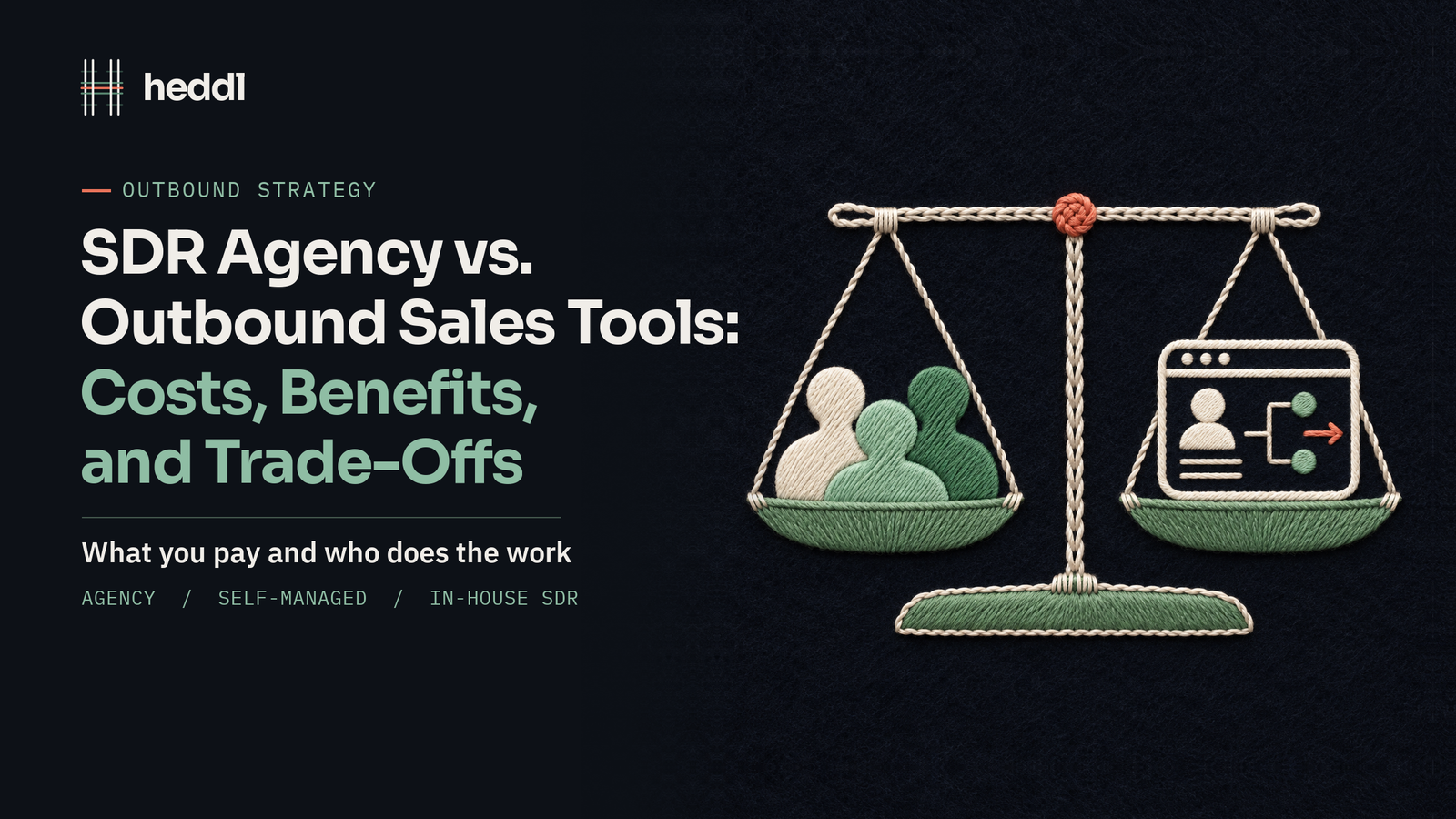
Running outbound yourself with sales tools is often the better option for early-stage startups still identifying their ideal customers, testing sales messages, or working with a limited budget. An SDR agency is more suitable for businesses with a proven outbound strategy that need additional capacity without hiring a sales team.
Hiring an in-house SDR offers greater control but involves recruitment, training, and ongoing management costs.
This guide compares the costs, benefits, and limitations of all three approaches. It also explains how small B2B teams can run signal-based outbound without a dedicated RevOps team.
SDR agency vs outbound sales tools: A side-by-side comparison
An SDR agency handles prospecting and outreach for you, while outbound sales tools let you manage the process yourself. Hiring an in-house SDR gives you a dedicated employee, but comes with additional hiring and management responsibilities. The table compares all three approaches across cost, control, ownership, and day-to-day execution.
| Comparison | SDR Agency | Outbound Sales Tools (Self-Managed) | In-House SDR |
|---|---|---|---|
| How you pay | Monthly retainer, per meeting, or both | Software subscriptions or usage-based credits | Salary, commission, benefits, and tools |
| Typical monthly cost | Around $4,000–$18,000 for retainers (Revnew, 2026) | Varies by tools, sending infrastructure, and usage | About $6,667 in median monthly OTE equivalent, plus overhead (Bridge Group, 2025) |
| Setup fees and commitments | Depend on the agency contract | Usually low upfront costs; subscriptions vary | Recruitment and onboarding costs |
| Time before outreach starts | After agency onboarding and setup | Once you complete the sending setup | After recruitment and initial training |
| Who writes messages | Agency team, with your input | You, with optional AI assistance | Your SDR, with your guidance |
| Product knowledge | Requires detailed briefing | Direct knowledge of your product | Develops through training and experience |
| Domains, lists, and sequences | Ownership depends on the contract | Usually yours when using your own accounts | Company-owned when kept in company systems |
| Buying signal usage | Depends on the agency's process | Available through supported tools | Depends on the tools and training provided |
| Your weekly involvement | Briefings, approvals, and reviews | Prospecting, messaging, and follow-ups | Coaching, management, and reviews |
| Scaling outreach volume | Expand the agency engagement | Add capacity, tools, or time | Recruit additional SDRs |
| Reporting | Agency reports and agreed KPIs | Tool dashboards and your own records | Internal dashboards and CRM reports |
| Best suited for | Teams ready to expand a repeatable outbound process | Founders testing their ICP and messaging | Teams with consistent prospecting demand |
Running outbound yourself is generally the better option when you're still learning which buyers respond and want to control your spending.
An SDR agency becomes more attractive when you have a repeatable approach but lack the time or people to expand it. Hiring an in-house SDR makes sense when outbound is an ongoing priority and your business can support a dedicated role.
How much does an SDR agency cost?
An SDR agency typically charges a monthly retainer, a fee per qualified meeting, or both. Many also charge a one-time setup fee or require a minimum contract term. The total depends on the outreach channels (email, phone, LinkedIn), how senior your buyers are, and how much of the work the agency takes on.
Agencies package their prices differently. One charges per appointment, another a monthly fee for a dedicated rep, so quotes rarely line up. A better yardstick is what the same role costs when you hire it yourself.
The Bridge Group's 2025 SDR report, a survey of 351 B2B companies, found:
Pay: Median on-target earnings of 80,000ayear(55,000 base and $25,000 variable). That's about $6,700 a month before benefits, tools and management time.
Ramp: An average of 3.0 months before a new SDR is fully productive.
Output: A median quota of 10 meetings held a month. Only 60% of SDRs reach it.
Tenure: An average of 1.9 years, with a median of 40% of SDRs leaving the role each year, promotions included.
For an SDR who hits quota, that works out to about $670 in pay per meeting held ($6,700 ÷ 10).
Use these numbers to judge an agency's quote:
| Pricing model | What to compare |
|---|---|
| Monthly retainer | Compare it with the $6,700 a month. Ask how many weeks pass before the first messages go out. |
| Per-meeting fee | Compare it with the $670 per meeting. Check whether a no-show still counts as a meeting. |
| Setup fee or minimum term | Add it to the first year's cost, because you pay it whether or not meetings come in. |
What does an SDR agency fee include?
Depending on the contract, an SDR agency may handle prospect research, contact list building, outreach copy, sending infrastructure, follow-ups, meeting scheduling, and performance reporting.
However, outsourcing does not eliminate your involvement. You still need to explain your product, approve messaging, review campaign performance, and attend qualified sales conversations.
Before comparing proposals, calculate the total commitment, including setup fees, retainers, meeting charges, and any separately billed tools or infrastructure.
Pro tip: Ask agencies to define a qualified meeting in writing, including job titles, attendance requirements, and no-show policies.
How much does running outbound with sales tools cost?
Running outbound yourself typically costs less upfront than hiring an SDR agency, but you need to account for software, sending infrastructure, and your own time. Your monthly expenses depend on which tools you use, how many prospects you contact, and how much of the process you handle manually.
The three main costs are:
Outbound sales tools: You'll need a way to find prospects, access their contact details, and manage outreach. Some platforms charge monthly subscriptions, while others use pay-as-you-go credits.
Sending infrastructure: Cold email requires domains and email accounts. Depending on your setup, you may also need tools to monitor deliverability.
Your time: You'll be responsible for selecting prospects, writing messages, reviewing responses, and improving campaigns.
Example monthly budget for a solo founder
For a founder managing LinkedIn and email outreach, here's an illustrative budget using heddl's pay-as-you-go pricing as of November 2026.
| Expense | Estimated cost |
|---|---|
| One connected LinkedIn account | $19/month |
| One connected email account | $16/month |
| 200 generated leads | $4 |
| 200 verified email addresses | $10 |
| Google Workspace Business Starter (flexible billing) | $8.40/month |
| One .com domain | Approximately $1/month equivalent |
| Total | Approximately $58.40/month |
This illustration assumes 200 successfully verified emails, a first-year domain price of $12.08 paid upfront, and no additional usage. Actual payments and renewal costs may differ.
How does this compare with hiring an in-house SDR?
According to The Bridge Group's 2025 SDR report, median annual on-target earnings were $80,000, with an average ramp period of three months.
The US Bureau of Labor Statistics reported that wages and salaries represented 70% of private-industry employer compensation costs in June 2026. Applying that percentage to $80,000 gives approximately $114,300 annually.
However, this is only a broad illustration, not a verified SDR employment cost, because on-target earnings and the BLS wage measure are different.
Pro tip: Put a value on your own time. If outbound takes two hours a week, include those hours in your budget before comparing tools with an agency or an employee.
When should you hire an SDR agency?
Hiring an SDR agency makes sense when you've identified your ideal customers, have sales messaging that generates qualified conversations, and need to increase outreach without hiring an internal sales team.
An agency can also help you enter new markets by providing experienced salespeople, established processes, and outreach infrastructure. However, successful outsourcing still requires clear targeting and regular involvement from your team.
Benefits of hiring an SDR agency
Experienced sales support: Agencies provide trained SDRs, established prospecting processes, and outreach infrastructure, reducing the work needed to launch campaigns.
More outreach capacity: Expand your prospecting efforts without recruiting, training, and managing full-time employees.
Reduced operational workload: Agencies handle prospect research, message preparation, follow-ups, and reporting so your team can focus on qualified sales conversations.
Limitations of hiring an SDR agency
Higher costs: Monthly retainers, setup fees, and minimum contracts require a financial commitment before results are guaranteed.
Limited product knowledge: External SDRs may need additional training to understand complex products and communicate their value accurately.
Less control over outreach: Depending on the agreement, the agency may manage your sending accounts, prospect lists, and campaign sequences.
Ongoing involvement: Your team still needs to review messaging, provide feedback, and monitor campaign performance.
An SDR agency may not be the best choice if you're still defining your target customers or testing your initial messaging. Founders selling complex technical products may also benefit from handling early conversations themselves.
How to choose the right SDR agency
Before hiring an SDR agency, evaluate these five factors:
Asset ownership: Confirm who owns the sending domains, prospect lists, campaign sequences, and conversation history after the contract ends.
SDR availability: Ask whether you'll have dedicated representatives or SDRs who manage multiple clients.
Performance reporting: Check whether reports include qualified meetings, response quality, and campaign improvements rather than outreach volume alone.
Contract terms: Review setup fees, minimum commitments, cancellation policies, and exit conditions.
Relevant experience: Request references from businesses selling similar products to comparable audiences.
Before signing, make sure your contract clearly states who owns the campaign assets and how you'll access prospect data if you stop working with the agency.
These details matter because outsourcing doesn't automatically guarantee results. For example, one business owner shared on Reddit that they spent $15,000 across two outbound agencies, facing poor targeting with one and receiving no meetings from the other.
Although this is an unverified individual experience, it highlights the importance of setting clear expectations and reviewing performance regularly.
When should you run outbound yourself with sales tools?
Running outbound yourself with sales tools is a good option when you're still identifying your ideal customers, testing sales messages, or working with a limited budget. It's especially useful for technical founders who can explain their products directly to potential buyers.
Sales tools can help you find prospects, send messages, and manage follow-ups while you retain control over your outreach strategy.
Benefits of running outbound yourself
Lower upfront costs: Start with a small software budget without committing to an agency retainer.
Greater control: Choose which prospects to target, what messages to send, and when to follow up.
Direct customer feedback: Learn about customer problems firsthand and improve your messaging based on real conversations.
Ownership of prospecting data: Retain control over your contact lists, sending accounts, campaign sequences, and customer insights.
Limitations of running outbound yourself
Time commitment: Prospect research, message creation, and follow-ups require consistent effort each week.
Technical setup: Configuring sending accounts, maintaining email deliverability, and managing outreach tools can take time to learn.
Limited capacity: Your outreach volume and ability to manage conversations depend on the time you can dedicate.
Running outbound yourself is a practical starting point for learning what works. As your sales process becomes more predictable, you can decide whether additional tools, an SDR agency, or an in-house representative would help you expand.
What does running outbound yourself require?
You don't need a dedicated sales team to get started, but you do need a consistent routine. Set aside a few hours each week to identify suitable prospects, send personalized messages, respond to interested buyers, and review your results.
More importantly, document what you learn. The objections, questions, and responses you receive will help refine your ideal customer profile and messaging.
For a practical first-week approach, see our guide on how technical founders can start outbound without a sales team.
How to run signal-based outbound without a RevOps team
You can run signal-based outbound without a dedicated RevOps team by tracking relevant buying signals, identifying suitable prospects, and reaching out with personalized messages. Start with two or three signals, use tools that connect prospect discovery with outreach, and review your results weekly.
Here's how to get started.
1. Identify two or three relevant buying signals
Focus on activities that suggest a potential need for your product rather than relying only on company size or job titles.
Common buying signals include:
Product recommendation requests: A prospect asks for software recommendations on LinkedIn, Reddit, or another public platform.
Hiring activity: A company recruits for roles related to the problem your product solves.
Funding announcements: A company raises funding and may begin investing in new tools or processes.
Competitor complaints: A prospect discusses limitations of an existing solution on a review platform.
These signals provide useful outreach context, but they don't always confirm buying intent. For more examples, see our guide to buying signals worth acting on.
Pro tip: Start with signals you can act on quickly, such as a prospect actively requesting software recommendations. Expand your monitoring once you understand which activities lead to meaningful conversations.
2. Use one platform for prospect discovery and outreach
Managing buying signals, contact information, and outreach across separate tools requires additional time and coordination.
A platform that combines these capabilities can reduce manual work. For example, heddl connects social listening, prospect discovery, contact enrichment, and outreach across LinkedIn, email, and WhatsApp.
You still choose which prospects to contact and when to launch campaigns, but you spend less time moving information between tools.
3. Review your outbound results weekly
You can track your initial outbound performance using a simple spreadsheet or your outreach platform's inbox.
Record five details:
Buying signal: What prompted you to contact the prospect?
Prospect: Who did you reach out to?
Message: What did you send?
Response: Did they reply, and what was their response?
Next step: Should you follow up, schedule a meeting, or stop outreach?
Spend 15 minutes each week reviewing which signals generate relevant conversations and which messages receive responses.
This gives you a practical way to improve your prospecting process without needing a dedicated RevOps team or complex CRM workflows.
How to combine an SDR agency with outbound sales tools
You can combine an SDR agency with outbound sales tools to increase outreach capacity while maintaining control over important sales activities. There are two practical approaches.
1. Let the agency manage outreach while you focus on priority accounts
An SDR agency can handle prospect research, initial outreach, and follow-ups. Meanwhile, your team can use buying signals to identify high-priority prospects and engage them directly.
This works well when you need consistent outbound activity but want to remain involved in important sales conversations.
2. Build your outbound process before outsourcing
Start by managing outbound yourself and documenting your target customers, messaging, common objections, and successful approaches.
Once you've identified what works, hand the process over to an SDR agency or an in-house SDR. This gives them a proven starting point and reduces unnecessary experimentation.
Whichever approach you choose, maintain ownership of your prospect data, sending accounts, and customer relationships.
Run outbound yourself with heddl
Running outbound yourself gives you control over your prospecting strategy, but managing multiple sales tools can take up valuable time. heddl helps founders and small sales teams manage prospect discovery, buying signals, and outreach from one platform.
Here's how heddl supports your outbound process:
Buying signal monitoring: Track relevant activity across nine sources, including LinkedIn, Reddit, X, and review platforms.
Prospect discovery: Identify potential buyers and prioritize them based on ICP fit and buying signals.
Contact enrichment: Find verified email addresses and phone numbers for relevant prospects.
Multichannel outreach: Create and launch outreach sequences across LinkedIn, email, and WhatsApp.
Unified inbox: Manage replies across all three outreach channels in one place.
You control when campaigns launch and how conversations are handled. Native CRM integrations are not yet available.
If you want to spend less time managing prospecting tools and more time talking to potential customers, explore heddl's 7-day trial to see how it fits your outbound workflow.